
Know What Your Company Is Running.
Bring the applications, services, recorded costs and decisions behind a software company into one evidence-backed workspace. Acquire it, rebrand it, and take it to the founders you already know.
Mission Control · A technical founder, a small software operator, or a venture studio with an engineering owner.
- Asking price
- Price on Request
- One-time acquisition.
- Availability
- Available
- No acquisition has been agreed, and none is in progress.
This is an application asking price. It is not a valuation of a business: there is no revenue, no customer base and no trading history behind it, and none is implied by the figure.
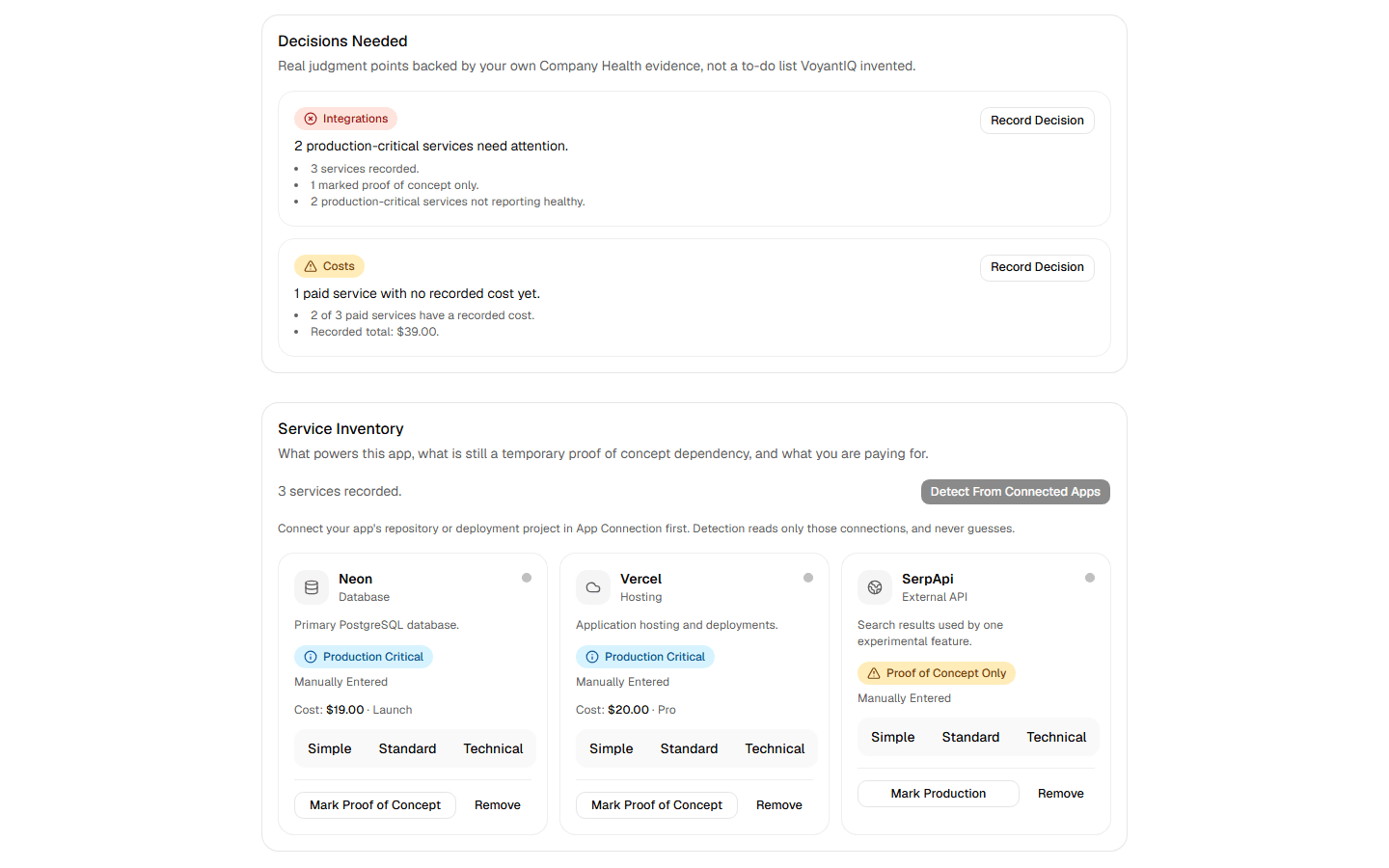
Mission Control showing Decisions Needed, and a service inventory recording what each service costs and what it powers. Photographed from the application running against a seeded database. The packaged standalone Mission Control repository. VoyantIQ also retains a separately evolved implementation in its platform repository, which is not what this shows and not what transfers.
How it actually works.
Connect an application
A read-only GitHub adapter returns repository metadata, the latest commit and the latest Actions workflow. A read-only hosting adapter returns recent project deployments, and the latest observed one supplies production evidence.
See the services it runs on, and what they cost
Detect From Connected Apps imports only the services those sources actually reported. Purpose, capability, billing type, plan, cost, renewal, criticality and provenance are all held against each one. Every cost figure is a number somebody typed.
Inspect an attention item and record the decision
Decisions Needed is derived from health factors that have real evidence behind them, so each item names what raised it. Deciding writes a dated entry with its rationale into an append-only log.
Three screens, in the order you meet them.
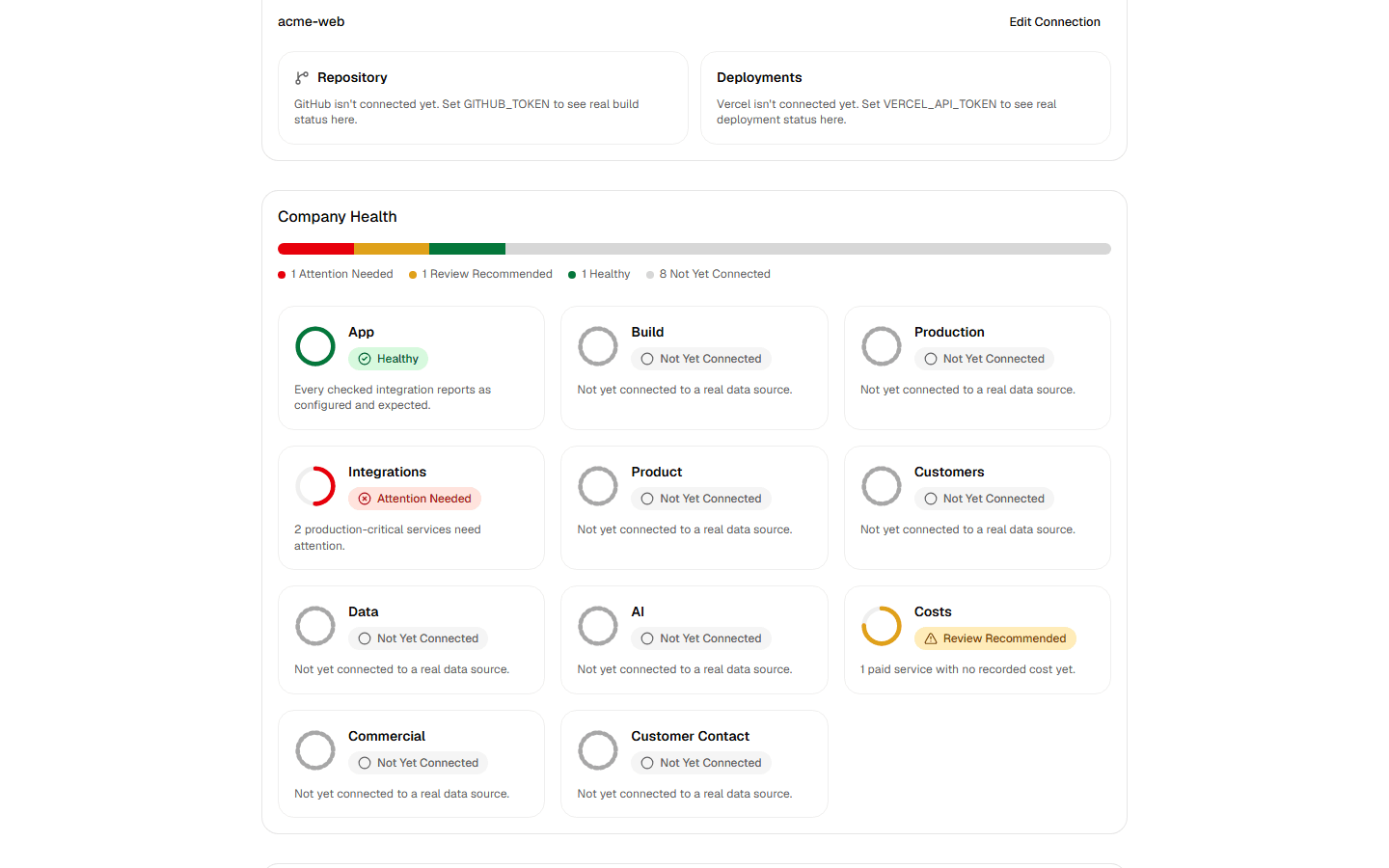
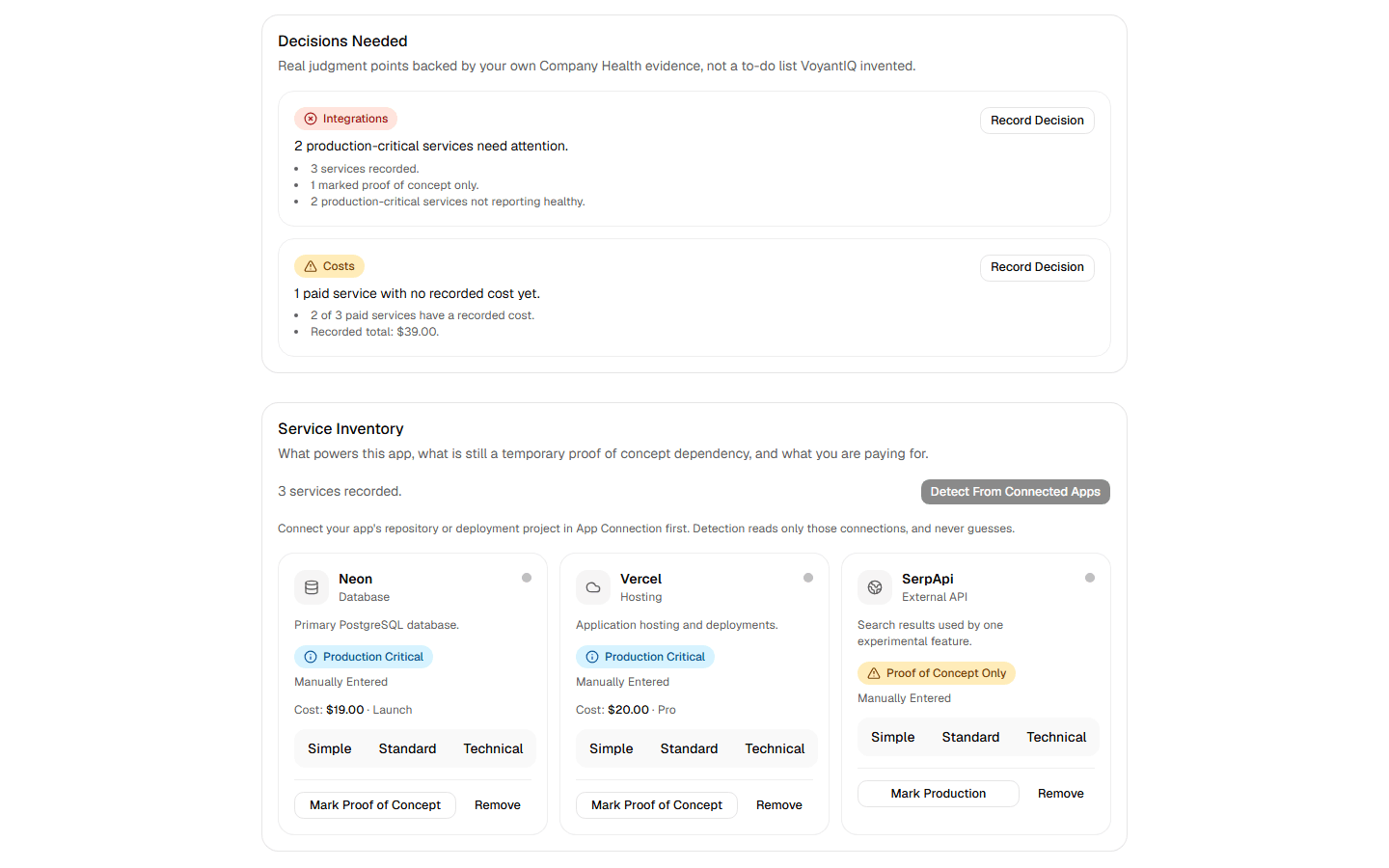
- Screen 1 of 3, showing
- Screen 2 of 3
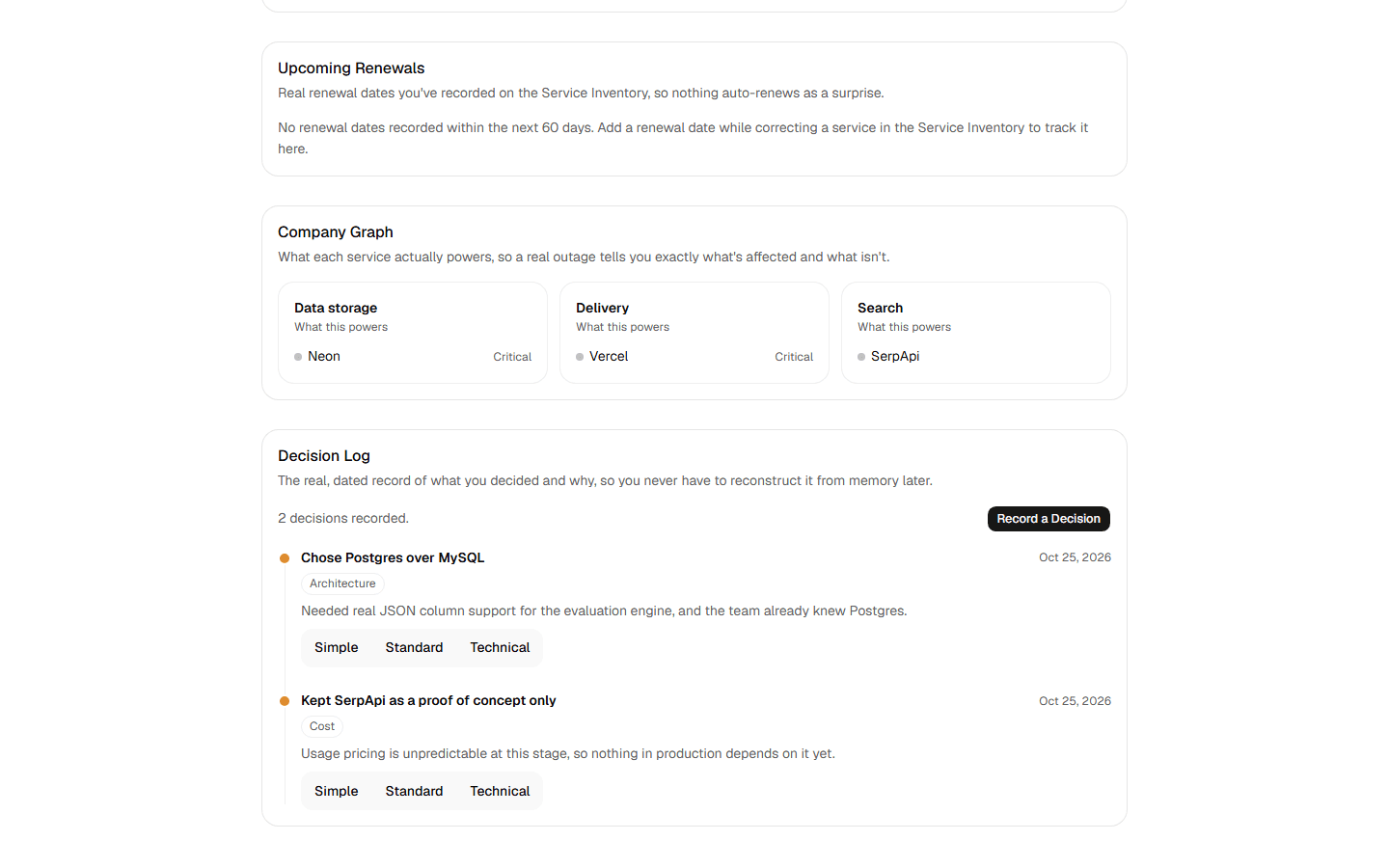
- Screen 3 of 3
Company Health reports eleven dimensions separately, and one with no connected source says so instead of inventing a score.
What you are actually buying, in four states.
No readiness percentages. A capability either runs in the version being sold, waits on something you supply, waits on rights we do not hold, or is not there at all.
Demonstrated in This Version
Present and working in the packaged repository this sale delivers, confirmed against its source.
Company Health reports eleven dimensions separately
Five compute from evidence: App, Build, Production, Integrations and Costs. The other six — Product, Customers, Data, AI, Commercial and Customer Contact — are deliberately unconnected and return unknown. Each dimension carries its own state, explanation, evidence and a real-evidence flag.
Read-only GitHub and hosting snapshots behind replaceable adapters
Repository metadata, latest commit, latest Actions workflow, and recent project deployments. A snapshot taken when the page is read, with no webhook, no polling and no stored deployment history.
A service inventory with provenance on every record
Purpose, capability, billing type, plan, cost, renewal date, criticality, proof-of-concept status and where the record came from.
Decisions Needed, derived rather than typed
Attention items come from computed health factors that have real evidence behind them, so each one can name what raised it.
An append-only decision log
Explicit human decisions with their rationale and date. Separate from, and narrower than, comprehensive change auditing.
A Company Graph grouping services by capability area
A curated relationship grouping with a category fallback and health attention, not a discovered dependency graph.
Three explanation levels over the same stored facts
Simple, Standard and Technical wording, all derived from persisted service and decision records.
Its own identity, database and authorization
Independent Better Auth identity, PostgreSQL, workspaces, and owner, admin, member and viewer roles. No VoyantIQ service is required at runtime.
Requires Buyer Configuration
In the delivered code, but inert until the buyer supplies an account, a credential, or a deployment of their own.
Hosting, a database and the environment reference
All on accounts the buyer owns. The application brings its schema and migrations; it does not bring somewhere to run them.
A GitHub operator token and a configured repository
Until one exists there is no repository evidence, and the dimensions that depend on it report unknown rather than healthy.
A hosting-provider token and project
The same applies to deployment evidence.
Every service cost and renewal date
Entered by hand. No connected provider billing API populates them.
Account recovery, which the application does not have
There is no email provider, no password reset and no email verification. A buyer running this as a paid service needs to build that before customers depend on it.
Multi-user onboarding
There is no member invitation flow, no company switcher and no per-client branding or export.
Requires External Licence
Needs rights VoyantIQ does not hold and cannot transfer. The buyer licenses it themselves or does without it.
The provider accounts it reads from are the buyer's own subscriptions
Nothing in the delivered application depends on a data licence VoyantIQ holds. The GitHub and hosting accounts it connects to are commercial relationships the buyer has or opens themselves.
One dependency licence item is recorded as unresolved
The LGPL sharp and libvips exception is an open item in the transfer pack, with a first-transfer review requirement still outstanding. It is named here rather than left in a document nobody opens.
Not Included
Not in the delivered version. Listed here so it is read before the purchase rather than discovered after it.
Autonomous operation
This repository makes no model call. The explanation levels are derived from stored facts, not generated, and nothing here runs a company on its own.
Automatic spend ingestion
No billing API populates costs, and there is no cost history table. Costs are manual.
Cost-change alerting
The cost-signal rules exist and are tested, but no application or interface path calls them and nothing supplies the prior snapshots they compare against. It must not be demonstrated as a working alert.
Automatic rollback, deployment control or fleet-wide discovery
The provider connections are read-only snapshots. Nothing in the application changes a deployment, and nothing scans a dependency graph or discovers every paid vendor.
Environment management
Environments are modelled with no working management surface.
A comprehensive audit trail
Service corrections overwrite values. There is no who, what, before and after record beyond the decision log and row timestamps.
The VoyantIQ company, brand, platform or accounts
Not the parent brand, the shared platform, provider contracts, domains, trademarks, hosting accounts, credentials or any user data.
Exclusivity over every related implementation, until it is written down
VoyantIQ retains a separately evolved Mission Control implementation in its platform repository. What transfers is this packaged standalone repository and its application-specific assets. Whether exclusivity means only that this Asset will not be sold again, or also restricts the seller's own related implementation, is settled in the agreement before completion rather than assumed from this page.
What this page does not claim.
Each of these is a sentence a page like this could easily say about Mission Control, and the reason it would be wrong.
Eleven dimensions is not eleven live feeds
Five are evidence-fed and six are explicitly unconnected. A page showing eleven healthy rings would be describing an application that does not exist.
A demo from the older platform can show more than the sale version
Mission Control also exists inside the VoyantIQ platform repository and has evolved separately there. Any screenshot or demo on this page identifies the standalone repository it represents.
Company-level evidence comes from the first reachable application
Company health takes evidence from the first application it can reach rather than aggregating an estate. The scale assumption is a small software company with a handful of applications and tens of services, and no performance envelope beyond that has been demonstrated.
Catalogues, scorecards and cost visibility are not an empty market
Port and OpsLevel overlap software catalogues, health and engineering context. Vantage overlaps cost visibility and Cledara overlaps subscription and renewal administration. What is specific here is the audience and the evidence discipline, not the absence of competitors.
What you receive
Built on Next.js, TypeScript, PostgreSQL, Drizzle ORM. A transfer check runs against a clean clone before any of it changes hands.
Full application source, commit history included
PostgreSQL schema and migrations
GitHub and hosting provider integrations
Deployment configuration and environment reference
Architecture and decision documentation
What you can look at first
A seeded sample company: connected-application evidence, a service inventory with recorded costs, and an attention item traced back to what raised it.
A deployed, standalone preview of the packaged application is not published. One is arranged during diligence, against the actual sale commit, rather than kept running here. A reasoning scenario and a deployed preview are different things, and naming both is better than letting one stand in for the other.
The recorded transfer evidence, dated.
Recorded 25 October 2026, against commit 7cc6f66028e2.
- A clean clone installed, migrated eleven tables and built.
- The recorded unit suite passed 82 tests.
- The import boundary check and a secret scan over the full history both passed.
- SPDX and CycloneDX bills of materials were produced.
- The dependency scan reported seven high advisories and no critical advisory on that date.
- The LGPL sharp and libvips exception remained an open decision item.
These are the repository's own recorded results from that date, not a fresh verification. The transfer process is re-run against the actual sale commit before any handover, and the current results are what the acquisition agreement refers to.
The schema and test counts shown elsewhere on this site — 11 tables, 82 passing — were measured on 30 October 2026. A skipped test is never counted as a passing one.
None of this establishes product quality, demand or revenue, and the pack itself says so. It establishes that the application builds, migrates and passes its own tests from a clean clone.
Mission Control is available.
A request starts a conversation. It is not a reservation, it holds nothing, and it commits neither of us to anything.